
Why Astro in 2026
Most websites aren’t apps. They’re pages — content people came to read, products they came to browse, stories they came to absorb. Somewhere along the way, we started building all of them like single-page applications anyway, shipping hundreds of kilobytes of JavaScript to render what is fundamentally text and images.
Astro asked a different question: what if we just… didn’t do that?
A year into building with Astro, the answer is clear. The bet paid off — and the rest of the industry is catching up.
The Zero-JS Thesis, Validated
Astro’s core idea is deceptively simple. Render everything to HTML on the server. Ship zero JavaScript to the browser by default. When a component genuinely needs interactivity — a form, a theme toggle, a search widget — hydrate just that piece, leaving the rest of the page static and fast.
Islands Architecture
An “island” is an interactive UI component on an otherwise static HTML page. Each island hydrates independently — so a slow-loading comment widget never blocks the hero section from being interactive. The rest of the page costs nothing.
This isn’t just a nice theory. It’s how this site works right now. The page you’re reading shipped almost no client JavaScript. The parts that needed it — navigation, theme switching — hydrated on their own schedule, without blocking anything else.
What’s telling is the direction the broader ecosystem has moved. React Server Components exist to solve the same problem: stop shipping so much JavaScript to the browser. Next.js, Remix, SvelteKit — they’re all converging on “render more on the server, ship less to the client.” Astro just started there.
What Changed in the Last Year
If Astro was promising in 2025, it became a safe bet in 2026. A few things happened.
Cloudflare Stepped In
In January 2026, Cloudflare acquired The Astro Technology Company. The entire team joined Cloudflare and kept working on Astro full-time. The framework stays MIT-licensed with open governance — but now it has the backing of a company whose entire business is making websites faster.
That’s not incidental alignment. A CDN company acquiring a performance-first framework is about as natural a fit as you’ll find in tech.
Astro will remain open source, MIT licensed, and community-governed. We’re not changing the license, the governance model, or the roadmap process.
Server Islands Grew Up
Astro 5 introduced Server Islands — a way to mark individual components for server-side rendering while the rest of the page stays static. Add server:defer to a component, and Astro streams it in after the static shell loads. Your CDN caches the shell, your server handles the personalized bits.
This was the missing piece. The old criticism — “Astro is just for static sites” — doesn’t hold anymore. You get pages that are 90% CDN-cached static HTML with pockets of dynamic, personalized content. No full-page server rendering required.
Tailwind v4 Went CSS-Native
Tailwind CSS v4 shipped a ground-up rewrite that replaced tailwind.config.js with CSS-native configuration via @theme. No more JavaScript config files — your tokens, custom utilities, and theme overrides all live in CSS, inspectable in DevTools, overridable at runtime.
For Astro projects, this is a natural fit. Astro bet on web standards over JavaScript abstractions. Tailwind v4 made the same bet for styling. The integration is now a single Vite plugin — cleaner, faster (5x faster full builds), and zero config by default.
Content Layer and Live Collections
Astro 5’s Content Layer API lets you treat external data sources — CMSs, APIs, databases — with the same type-safe schema validation as local Markdown files. Astro 6 promoted Live Content Collections to stable, enabling runtime content fetching without rebuilds. Your blog posts can come from a headless CMS, your product data from an API, and everything gets Zod-validated type safety.
What This Looks Like in Practice
Here’s a pattern that captures the whole philosophy: a feature card component using semantic design tokens, with an interactive detail toggle that only hydrates when the card scrolls into view.
---import ToggleDetail from './ToggleDetail';
export interface Props {  title: string;  description: string;  detail: string;}
const { title, description, detail } = Astro.props;---
<article class="rounded-lg border border-border bg-surface p-6 shadow-sm">  <h3 class="text-lg font-semibold text-foreground">{title}</h3>  <p class="mt-2 text-muted-foreground">{description}</p>
  <!-- Only this piece ships JavaScript, and only when visible -->  <ToggleDetail client:visible detail={detail} /></article>
The <article> is pure HTML and CSS — zero JavaScript cost. The ToggleDetail component uses client:visible, so it doesn’t hydrate until the user actually scrolls to it. On a page with ten of these cards, you’re hydrating exactly the ones in the viewport, when they appear.
Every class references semantic tokens: text-foreground instead of text-gray-900, bg-surface instead of bg-gray-50, border-border instead of border-gray-200. The tokens handle light mode and dark mode automatically — no manual dark: variants scattered through your markup.
The Numbers Are In
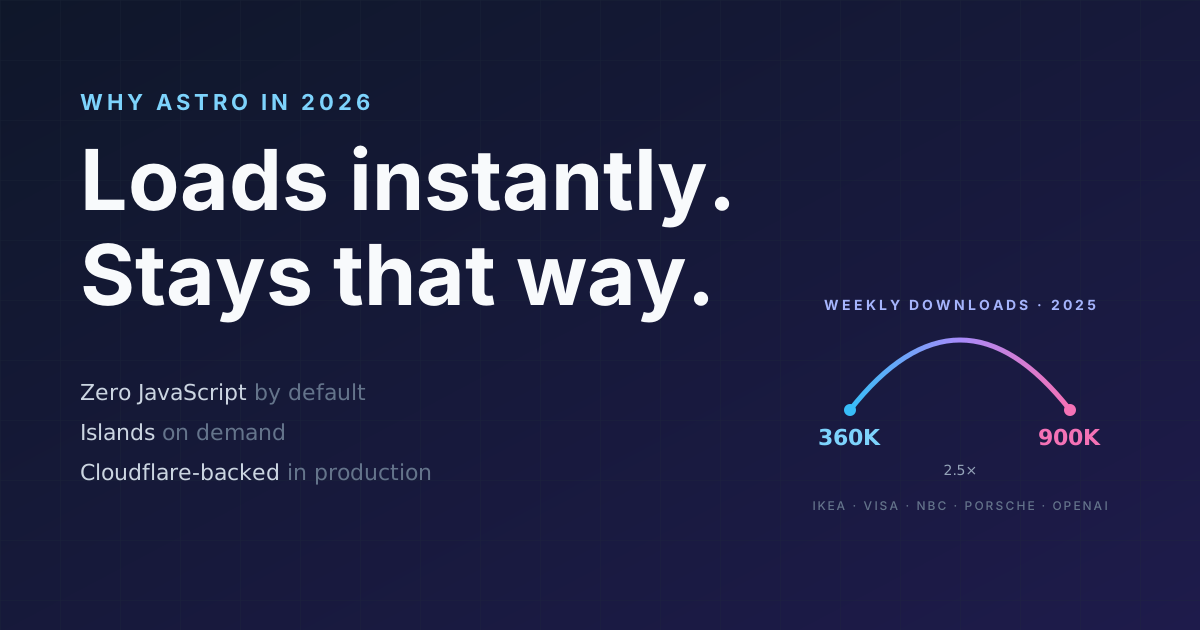
Astro npm downloads grew from 360K/week to over 900K/week in 2025 — a 2.5x increase. GitHub stars passed 55K. Production users include IKEA, Visa, NBC News, Porsche, and OpenAI. This isn’t an experiment anymore.
The Right Tool for the Job
Astro isn’t trying to replace React or Next.js for building complex web applications. A SaaS dashboard with real-time collaboration, a social media feed with infinite scroll — those benefit from a fully interactive client-side approach.
But for content sites, marketing pages, documentation, blogs, and portfolios — the sites that make up the vast majority of the web — shipping megabytes of JavaScript was always the wrong answer. Astro makes the right answer the default.
You’re reading this on an Astro site right now. It scored 95+ on Lighthouse without any manual performance tuning. The CSS is under 50KB. The page loaded before you had time to wonder whether it was fast.
That’s the argument. Not a theoretical one — a felt one.